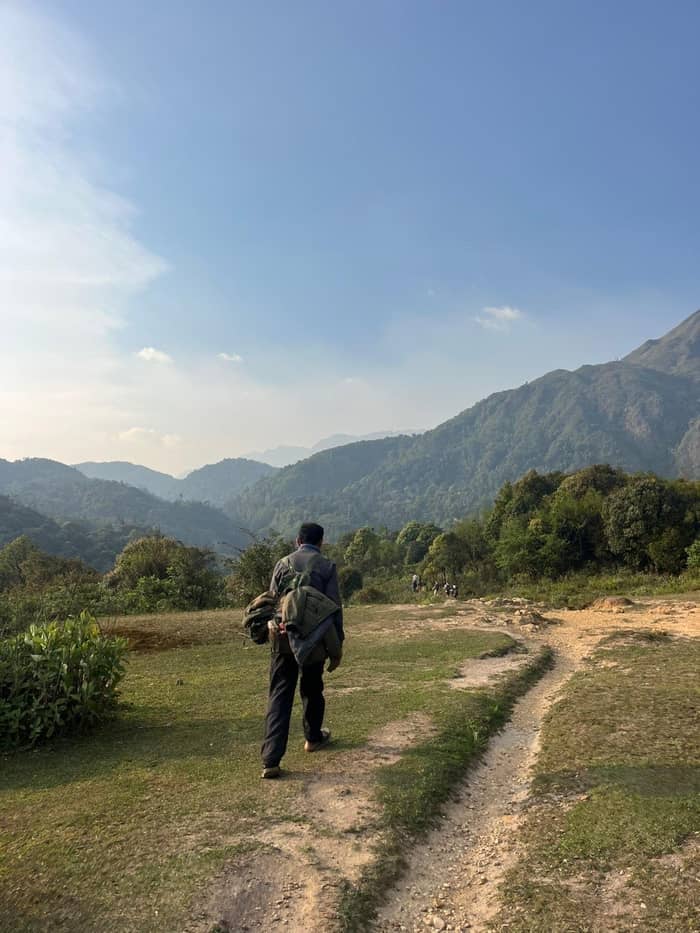
1 day
Site one-day trek
Small group with a local guide
- StartAbout 1,900 m
- GroupUp to 10
- GuidesEnglish and French
- Pricefrom $55
Cost for your group
One-day Fansipan trek from Sa Pa
★ 4.9 · 133 user reviews
Compare 4 choices
Set your party size to see the starting cost of each Fansipan trek.
≈
View≈
View≈
View≈
ViewGetYourGuide's starting prices, converted at the ECB reference rate; exact pricing appears when you book.
What the walk to the top of Fansipan really involves: the trailhead, the hours up and down, the fitness it asks for, and the park rules that decide who may go and with whom.
Editorial team, fansipantour.top · Updated November 16, 2026 · Read in 9 min
In brief
The Fansipan trek is the walk to the top of Vietnam's highest mountain on your own legs, through Hoang Lien National Park, instead of the cable car that now lifts visitors to the summit area. The tour this site sells is written up as a day-long version: the day begins with a pickup in central Sa Pa and a drive to a start at about 1,900 meters, then comes the walk up to the 3,143 meter summit and the ride back in the afternoon. It is the version for people who want to earn the view and are happy to spend a full day doing it.
Vietnam Tourism recalls that reaching the summit used to take two days of hard trekking, and the arrival of the cable car has not emptied the trail.2 By the end of October 2025, according to the Lao Cai provincial newspaper quoting the park centre, nearly 23,000 visitors had explored Hoang Lien National Park and about 6,000 of them had climbed Fansipan on foot.3 The walkers are a real and regular part of the mountain's year, and the park has built its rules around them.
This page covers the route, the hours, the difficulty and the rules around the guide. The choice between the trek and the cable car is a separate question with its own page, and the weather, the packing list and the road from Hanoi each have theirs too. Below you will find a timeline of a trek day, an elevation chart, a side by side table of the trek listings, a decision helper and a checklist for the trailhead.
Compare the trek listings
| Listing | Day length | On the trail | Group size |
|---|---|---|---|
| Site one-day trek | 1 day | Start at about 1,900 m | Up to 10 |
| One-day trek with a long descent | 1 day | 6 hours up, 3 hours down | Not given |
| Full day from Tram Ton Pass | 10 hours | 12 km each way | Up to 15 |
| Day from the Sa Pa Stone Church | 9 to 10 hours | Hiking and a scenic drive | Not given |
| Two-day trek | 2 days | 26 km in all | Not given |
Hours and distances are the listings' own and are not a promise for your group; the operator confirms the start time and the stops.
Treks up Fansipan do not all begin at the same place or run to the same clock, which is why two listings can quote very different days. In the site's record your pickup point is in central Sa Pa, and you are taken to a start at about 1,900 meters, stop for lunch part-way up and come down in the afternoon. A second day-long listing breaks the day into a car ride of 30 minutes, about 6 hours of hiking up, a lunch at 2,800 meters, about 3 hours of hiking down and a car ride of 30 minutes back.
Another listing, a full day of 10 hours for a group limited to 15, starts from Tram Ton Pass and gives the route as 12 km each way with about 6 hours to reach the top. A further listing runs the same mountain over 2 days and 26 kilometers. Reading the stop list matters more than reading the title: a Fansipan hike in one listing is a long day and in another a plan spread over 2 days.
Use the timeline below as a model of one long day, with timings taken from the day-long listing that states them, and treat the hours as the record's, not a promise. Weather, the pace of the group and the trail condition move every figure, and the site's own record says the plan can change for safety. Your guide may shorten or reshape the day if conditions turn. Ask your operator for the start time, and for what happens to the plan if the group runs late.
The numbers that frame the trek come from several sources, so they are worth lining up. Vietnam Tourism puts Sa Pa town some 1,600 meters above sea level, the site's record starts the walk at about 1,900 meters, a day-long listing eats lunch at 2,800 meters, and the operator of the cable car says its upper complex stretches from 2,900 meters to the top.5,6 The summit itself stands at 3,143 meters in the operator's description.4
Put together, the trek is a long and steady gain in altitude, and the operator that runs the cable car says its summit funicular spares visitors a climb of 600 stone steps at the very end.7 No official source gives a pace per hour, and your group will not walk at an average. What the records do give is the order of effort: a long first part through forest, a lunch break at about 2,800 meters on one listing, and a final stretch higher up.
Distances follow the same pattern of difference between listings. The full day listing quotes 12 km each way, the 2-day listing 26 kilometers over the two days, and the day-long listings quote hours rather than a distance. If you are comparing, compare hours on the trail, the length of the descent and what the price includes, in that order, and keep the elevation chart in mind: the climb is long and steady, not a single hard hill.
Choose your trek
Say what matters to you, and the row points to the listing that fits it.
If I want the shortest way to the top on foot
The site's one-day trek
It starts the climb at about 1,900 meters and runs in groups of up to 10.
If I want a long route with the trailhead at the pass
The full day from Tram Ton
It gives 12 km each way and about 6 hours to the top.
If I want more time and not one long day
The two-day trek
It spreads 26 kilometers over 2 days.
If I may be too tired to walk down
A listing with a cable car option
On the 2-day listing the guide can arrange a cable car ride for the way down.
If I cannot walk that far at all
The cable car instead
The operator's summit funicular spares a climb of 600 stone steps at the end.7
Three ways to do it
1 day
Small group with a local guide
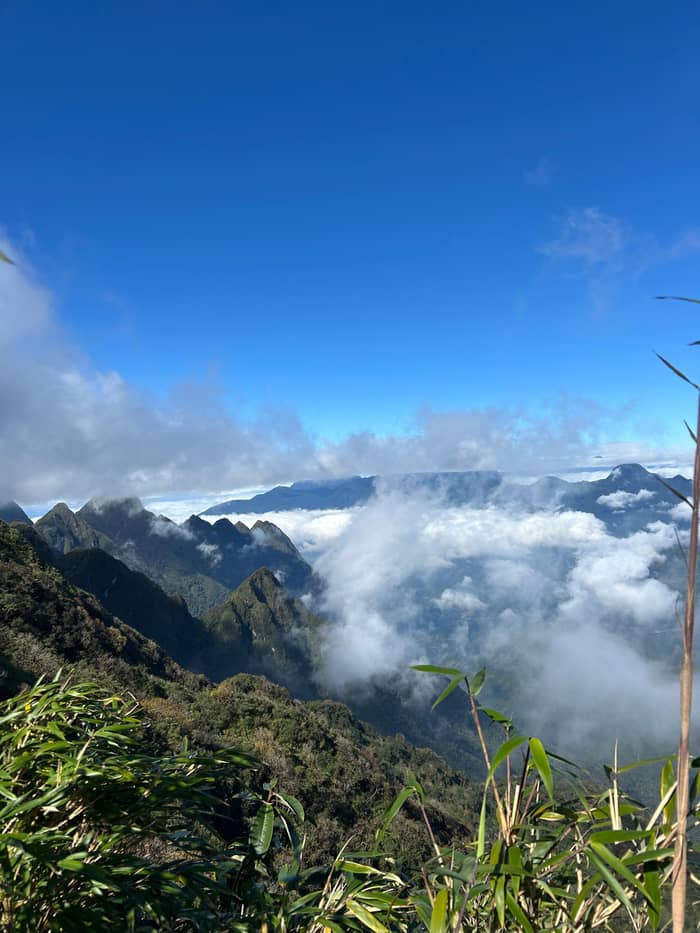
10 hours
A long route in one day
2 days
More time on the mountain
The park is firm about this. In the Lao Cai provincial newspaper, the park's tourism centre says that a forest permit and a guide or porter are the most important rules for entering Hoang Lien National Park, and that the permit lets the park keep track of how many people are inside.1 A local guide knows the terrain, the weather and the dangerous spots, and can act in an emergency. That is why the trek is sold as a guided product and not as a map and a good luck.
The same article explains the cause. Some foreign visitors have entered the park on their own, found trails on social media and got lost, and rescue then costs time and resources.11 The park trains porters, guides and its rescue team on a regular basis, and it has put warning and direction signs up in English and Vietnamese.12,13 The paper also says that online groups teach how to dodge the ticket and the controls, and calls that a serious breach of the rules on ecotourism and forest management.
For you, the practical result is simple. Book a trek that includes the guide and the paperwork, and send the details the operator asks for. One day-long listing asks guests to send their passport after booking so that the climbing procedure can be arranged. Do not try to save money by walking in alone: the rules, the patrols and the lost visitor cases all point the same way, and nothing on this page is a promise of safety on a mountain.
One long day
Pickup
The site's record has pickup in central Sa Pa before the transfer to the trailhead.
Transfer
A day-long listing gives a car ride of 30 minutes before the hiking begins.
Climb
The same listing gives about 6 hours of hiking up, with a lunch break at 2,800 meters.
Summit
The summit stands at 3,143 meters, and the listing's time at the top is marked optional with an extra fee.4
Descent
The listing gives about 3 hours of hiking down before a second car ride of 30 minutes.
Every listing is blunt about difficulty, and so should you be. The site's record says the climb needs good physical condition, and a second day-long listing calls it a challenge that asks for a good fitness level and warns that rain and strong winds can complicate the trip. A hiker who walks hills on weekends is in a different place from someone who has not walked far in a year, and the long steady climb punishes the second kind of preparation.
Limits are stated more precisely on the longer and tougher listings. The 2-day trek advises elderly people against the long route and rules out children under 17. A day-long listing from the Sa Pa Stone Church does not recommend the day for people with heart conditions or serious mobility issues. A Hanoi 2-day tour that includes Fansipan says the mountain needs good health and is not suitable for people with acrophobia.
None of that makes the cable car a lesser choice. For families with young children, for older relatives and for anyone short of time, the operator describes a ride and a funicular that spare the climb, and Vietnam Tourism says the ride to the summit takes 15 minutes.7,14 If someone in your group cannot trek, split the plan: the walkers take the trail and the others take the ride, and you meet at the top. The trek versus cable car page weighs that choice in full.
Video
Journey with Jack on YouTube · Playback files load only once you tap play.
It used to take travellers two days of hard trekking to reach the summit.
Before the trailhead
The mountain makes its own weather, and the operator that runs the cable car says the summit is often significantly cooler than central Sa Pa.8 It also says conditions can change quickly from sunny to foggy at altitude.15 On the trail that means a climb that begins in shirt sleeves at the trailhead can end in gloves, and a rain jacket is worth packing whatever the month, as a Sa Pa listing recommends.
The operator gives reference summit ranges by season: 5 to 15 degrees Celsius in spring and autumn, 10 to 20 degrees Celsius in summer and 0 to 10 degrees Celsius in winter, with a fall below 0 possible in a severe cold spell.16,17,18,19 Summer is also the rainy season, when showers, thunderstorms, thick fog or strong winds can reduce visibility near the peak.20 The weather page of this site lays the seasons out month by month.
For a first trek, spring and autumn look like the balanced choices on the operator's numbers, and the trail can be done in other seasons if you accept the trade. Rhododendron forests begin to bloom from around March to May according to the operator, and October opens the cloud hunting season in its autumn guide.21,22 Whatever the month, ask the operator how it handles a day with a bad forecast; the site's record says the plan can change with weather and trail conditions.
The park asks something specific of walkers beyond the permit. The provincial newspaper says all personal waste, including organic waste such as fruit peel, has to be carried out of the forest.9 It also says the dry winter climate keeps Hoang Lien National Park at a high risk of forest fire, which makes a cigarette end or a camp spark a real hazard.10 One Sa Pa listing adds that pets are not allowed under the rules of the national park. These are the habits of the trek, and your guide will remind you of them.
Then comes the descent, which is where the knees pay. The day-long listing that states it gives about 3 hours of hiking down, and the site's record puts the return transfer after the descent. The cable car is a separate, optional purchase that sits outside the trek price, as the record puts it. A 2-day listing lets a tired walker ask the guide to arrange a cable car ride down, at an extra 700,000 VND.
Treat that as an option to agree with the operator before the day, and not as a plan to invent at the top while your legs are shaking. Ask who buys the ticket, whether the ride is available when you reach the summit, and how you get back to your pickup point afterwards. If you plan to walk the whole way, use the extra hours to eat, drink and warm up at the summit, and keep an hour in hand for the descent light.
FAQ
One listing gives about 6 hours up and about 3 hours down with car rides of 30 minutes, another gives a full day of 10 hours.
The park centre calls a forest permit and a guide or porter essential for entering Hoang Lien National Park.1
The site's record says the climb needs good physical condition, and the 2-day listing advises elderly people against the long route.
The operator of the cable car gives 3,143 meters, and the site's record starts the climb at about 1,900 meters.4
A 2-day listing lets the guide arrange a ride down on the cable car for an extra 700,000 VND, while the site's record keeps the cable car outside the price.
The 2-day listing rules out children under 17, and the site's tour is run in groups limited to 10.
A Sa Pa listing says pets are not allowed under the regulations of Hoang Lien Son National Park.
Sources
Planning the Fansipan climb? Ask a real person here.