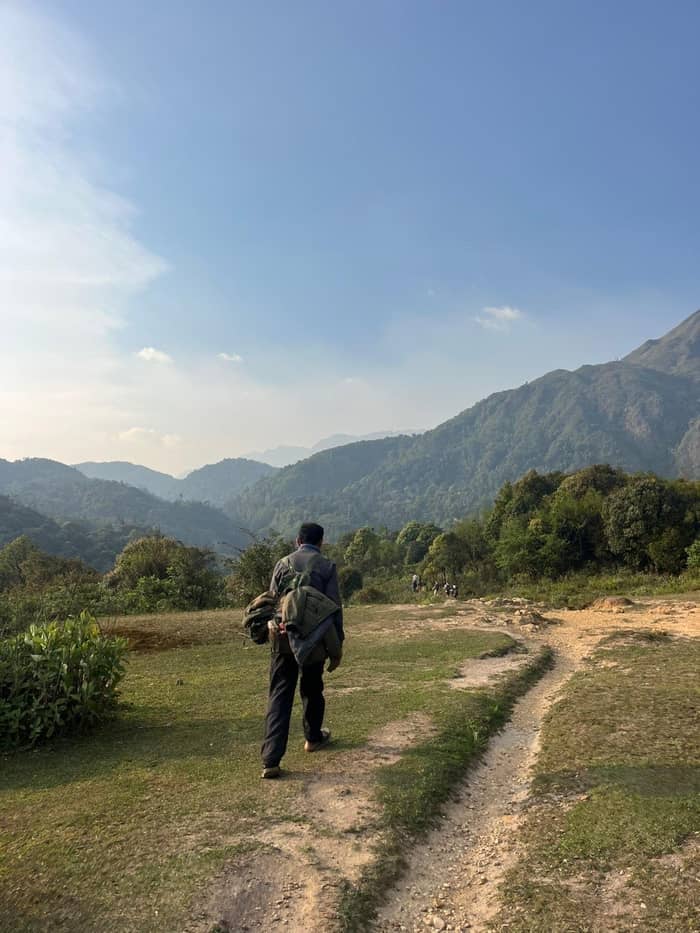
One stick
Single hiking staff
Simple and cheap
- Best forBalance on steps and mud
- CarryEasy to hand over
- Weak spotLittle help for both knees
- BuySa Pa shops or at home
Checklist you can tick
One-day Fansipan trek from Sa Pa
★ 4.9 · 133 user reviews
Summary
A hiking staff is a single stick for balance, trekking poles work as a pair, and blunt-tipped poles are allowed in checked bags on flights screened by the TSA.
Poles in brief
Prep list · 10 items
Tap to check items off; your progress is remembered on this device.
0 / 10 ready
You are ready. Only the date and your pickup are left to choose.
Book your seatA packing guide for the day-long climb: which stick to carry, which layers suit the season, what the operators say to bring, and what to do with your legs once you are back in Sa Pa.
Editorial team, fansipantour.top · Updated November 16, 2026 · Read in 9 min
In brief
The first question most people ask before a long climb is whether to carry a hiking staff or a trekking pole, and the honest answer depends on what the day asks of you. A hiking staff is a single stick, often a plain one in wood or metal, that steadies one side of the body and costs very little. A trekking pole usually comes as a pair with a strap and an adjustable length, so both arms work with the legs. On a day that climbs through forest and ends in a long descent, the pair has more to offer.
Fansipan puts both to the test in different places. Uphill the pair pushes you along and spreads the effort; downhill a stick in each hand takes load off the knees, which is the part of the day when legs complain. The cable car's own operator mentions 600 stone steps at the top, a reminder that the mountain ends in stairs as well as dirt.3 A staff is lighter to carry when you do not need it, and easier to hand to a guide; a pair is easier to forget at the bottom of a rucksack.
One thing no record settles is whether your operator lends poles. The site's tour record names a local guide, a lunch and small groups, and says nothing about equipment hire, so ask when you book and do not assume. If you own poles and trust them, bring them. If you do not, a single staff, or a pair borrowed or bought in Sa Pa, is a reasonable choice for a trail that the listings describe as a challenge.
Layers by season
| Season | Summit range | What the operator advises |
|---|---|---|
| Spring | 5 to 15 degrees Celsius8 | Warm jackets, scarves, non-slip shoes12 |
| Summer | 10 to 20 degrees Celsius9 | Light jacket, windproof layer, grippy shoes13 |
| Autumn | 5 to 15 degrees Celsius10 | Moderately thick jacket, scarf, non-slip shoes14 |
| Winter | 0 to 10 degrees Celsius11 | Down jacket, thermal pants, hat, gloves15 |
Ranges are the cable car operator's reference ranges for the summit, not a forecast and not the temperature in Sa Pa town.1
What makes a good trekking pole is mostly what you will not notice at the end of the day. It should be light enough that your shoulders forget it, adjustable so you can shorten it uphill and lengthen it downhill, and fitted with a grip and a strap that stay comfortable with wet or cold hands. Locks that slip when wet are a real annoyance, so test the pole at home, loaded, before the trip and not for the first time at the trailhead.
The tip is the other detail. Metal tips bite into dirt and stone, while rubber caps grip better on rock and protect surfaces that can be scarred; which tip to use depends on the trail, and your guide will tell you what the route suits. Mud, roots and wet stone are what to expect on a mountain whose summit season runs from showers to frost, so a pole with a tip that you can swap or cover is worth having.5 Keep a spare basket or cap in your pack if the pole takes one.
There is also the matter of manners on a protected mountain. The park is an ASEAN Heritage Park, in the words of the Lao Cai provincial newspaper, and asks visitors to carry out all personal waste including fruit peel.6,7 Use poles to protect the path, not to widen it: stay on the trail your guide chooses, and do not cut corners on switchbacks. If your poles have a leather or cord strap, check the knot before the descent starts.
Poles are a question for the airport as much as for the trail, and the clearest official answer comes from the US Transportation Security Administration. It says blunt-tipped hiking poles are permitted in both carry-on and checked bags, with screening like any other item, while sharp-tipped poles may not go in the cabin as carry-on.2 That rule applies at US checkpoints, so treat it as a guide, and check the rules of the airports and airlines you will actually use.
The agency also tells travelers to check with their airline to see whether hiking poles are accepted as carry-on items.16 The simplest plan is the safe one: collapse the poles, cap the tips and put them in checked luggage, where the same agency allows them.2 If you want them in the cabin, ask the airline first and keep the tips covered. On arrival in Vietnam, nothing on this page is an official Vietnamese rule; if your tour needs poles, it is easy to buy or borrow a staff in Sa Pa.
Packing poles for the flight home is the other side of it. After a day on the trail, mud sits in the joints and the tips, so wipe them down in Sa Pa before you pack. A pole that arrives damp inside a suitcase can stain clothes and spoil a lock. Wrap the tips and strap the sections together so they do not snag on the bag lining, and keep the cap for the metal point in a pocket where you can find it again at the airport.
Choose your kit
Tell us how you walk, and the row points to the stick and the layer for the day.
If My knees complain on long descents
A pair of trekking poles
A day-long climb ends in hours of descent, and poles share the load between arms and legs.
If I only want something for balance
A single hiking staff
The staff costs little and steadies one side; it is simple to carry on and off the trail.
If I am travelling in winter
Down jacket, hat and gloves
A winter reference of 0 to 10 degrees Celsius applies at the top, and a hard cold spell goes lower.11
If I am travelling in the wet months
A light jacket and a raincoat
The operator says June to August is the wetter part of the year and heavy showers can affect trekking trails.17,18
If I want to fly with poles
Pack them in checked luggage
The US security agency allows blunt-tipped hiking poles in checked bags.2
Pick your stick
One stick
Simple and cheap
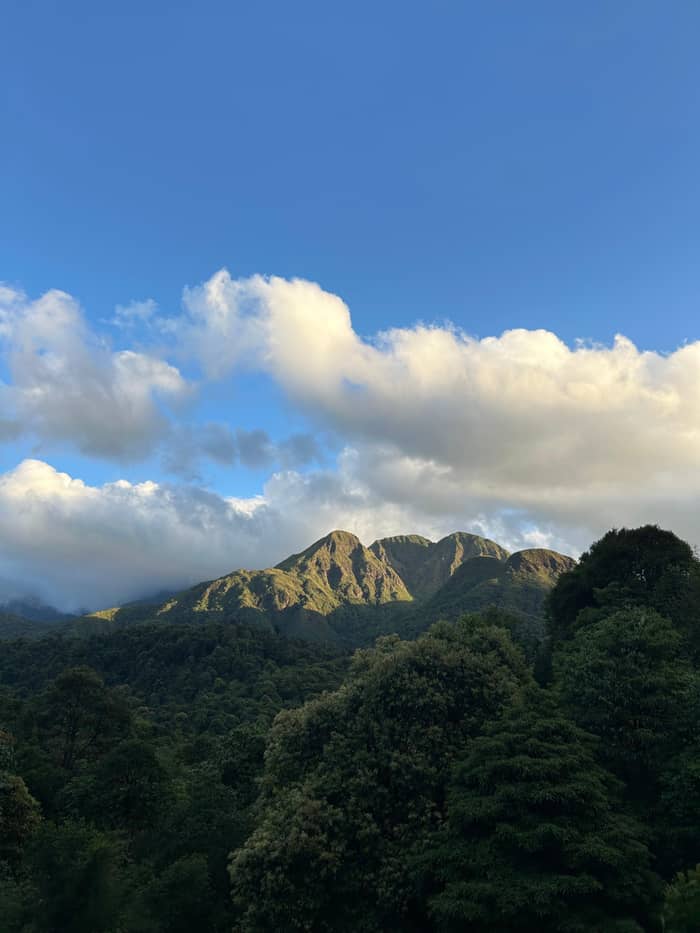
A pair
For a long descent
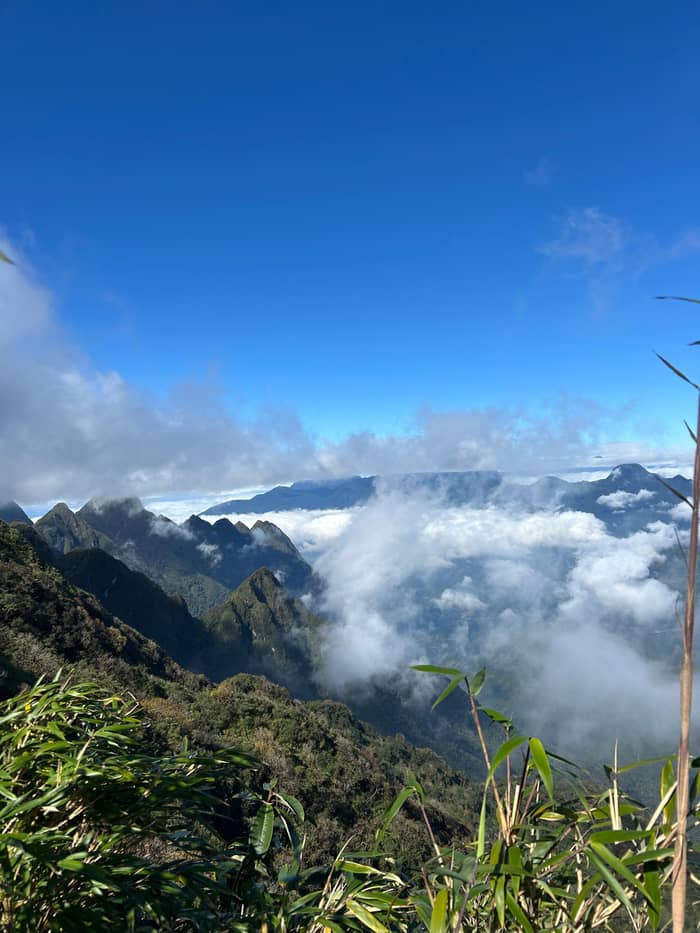
Hands free
If the route is short
How do you prepare for hiking and trekking when the mountain is far from home? Start with the legs. Fitness comes first: the site's tour record asks for good physical condition and another listing for the same peak calls the climb a challenge, so train with hills, stairs and a loaded day pack in the weeks before the trip. Walk in the shoes you will wear and break them in; a new pair on a descent of hours is a recipe for blisters.
Paperwork is also preparation. A listing for the same peak wants a passport copy sent in right after you book, to arrange the climbing formalities, and the park centre separately calls a permit and a guide essential for entering Hoang Lien National Park.22 Do not leave this to the night before: send what the operator asks for as soon as you have booked, and keep a copy of your passport page on your phone.
Then plan for the altitude and the clock. From a start near 1,900 meters in the site's record to the 3,143 meter top, the day carries you into thinner and cooler air than Sa Pa town has.23 Drink steadily, eat on schedule, and say so to your guide at the first sign of trouble. A short night before the trek is a bigger risk than a missing gadget.
Plan the cost
Choose a headcount and each Fansipan day shows the price it starts from.
Compare 4 choices
Choose a headcount and each Fansipan day shows the price it starts from.
≈
View≈
View≈
View≈
ViewGetYourGuide's starting prices, converted at the ECB reference rate; exact pricing appears when you book.
Before and after
Weeks before
Good physical condition is what the site's record asks for, so practise with hills and a loaded pack.
After booking
Passport details go to the operator early; one listing wants them right after booking.
Night before
Inner layer, fleece and shell on top, with a rain jacket and a sun hat in the day pack.
Trek day
Dong in a dry bag; the site's record lists a lunch stop on the climb.
Next day
A herbal bath in Ta Phin costs 150,000 VND for a half-hour soak.4
Dress for the summit, not for the town. Sun World, which runs the cable car, says conditions can change within the same day in Sa Pa, from cool mornings to a warmer midday and cooler evenings, so layers are the working answer.24 The operator's tip is to wear several light layers, since early morning, midday and evening feel noticeably different.19 The same pages describe the top as often much colder than the town centre, with weather that can turn from sun to fog in a short time.1,25 Start with a thin inner layer, add a fleece or similar, and finish with a windproof shell, which lets you adjust at the lunch stop and again at the top.
By season the operator's guidance is specific. In spring it advises warm jackets, scarves and non-slip athletic shoes; for summer a light jacket, wind-proof clothes and soles with a good grip; and for winter heavy down jackets, thermal trousers, woollen hats, gloves, scarves and non-slip shoes.12,13,15 For October and November it suggests a moderately thick jacket, a scarf and non-slip shoes.14 For the wetter months, which it places from June to August, it adds a thin raincoat, water-resistant shoes and a cover for electronic devices, as heavy showers can affect the trails.17,18,20 A listing from Hanoi recommends a scarf, a hat, sunglasses and sun cream as well.
The table below sets the seasons side by side with the operator's reference summit ranges, and the chart shows the top of each range. Spring and autumn sit around 5 to 15 degrees Celsius at the top in the operator's figures and summer around 10 to 20.8,10,9 Use them to decide how many layers to carry, and remember the numbers are a reference, not a forecast; the weather page of this site covers the months in detail. If your trek falls in winter, take a spare pair of socks and gloves, as wet hands and feet turn a cold day into a hard one. Keep them in a plastic bag inside the day pack so they stay dry whatever the weather does.
Video
James Goodwin on YouTube · Playback files load only once you tap play.
Blunt-tipped hiking poles are allowed in carry-on or checked bags and must be screened like other property.
Read what your listing includes before you pack. The site's record lists pickup from central Sa Pa, a transfer to the trailhead, a midday lunch stop, a local guide and the return transfer, with groups limited to 10. The cable car ticket is a separate, optional purchase outside the trek price, so you do not need to carry cable car money unless you decide to ride down.
What the tour does not mention is what you should plan yourself. A private Hoang Lien trek listing recommends a small day pack, insect repellent, sunscreen, a raincoat and a sun hat, with warm clothes for the winter months from November to March. A Hanoi tour listing adds medication you need and cash in Vietnamese dong, because banking in Sa Pa sometimes does not function well. Bring a modest amount of cash, a phone with a power bank and a plastic bag for wet clothes, and keep the passport copy and the booking confirmation where you can reach them without unpacking.
Leave the rest in Sa Pa. A day pack that is light on the climb is also easier on the shoulders on the way down, so keep spare clothes, laptops and anything you do not need at your hotel. Carry your own rubbish out in a pocket bag, fruit peel included, as the park asks, and leave no cigarette ends on a mountain the provincial paper calls high-risk for forest fire in the dry winter.7,21
What to do after trekking is a fair question, as the day after Fansipan is when your calves speak. Eat properly and drink water in Sa Pa the same evening, and keep the next morning free of schedules. Walk slowly downstairs, stretch the calves and the thighs, and do not plan a second long day on the same legs. If you have a night booked in Sa Pa, treat it as recovery, not as another trek start.
Sa Pa has a local remedy for tired muscles. Vietnam Tourism describes a herbal bath made with bark and leaves harvested in the forest, a recipe the Red Dzao women have perfected, and says a half-hour soak in a bathhouse in Ta Phin village costs 150,000 VND.26,4 Ask your hotel how to reach it, or whether it offers its own herbal bath, and book a slot for after the walk.
If your onward plan is a long road, protect your legs for it. A transfer of 6 hours, such as the limousine from Sa Pa to Ha Giang that a listing describes, is a lot of sitting on tired knees. Choose a seat with leg room, stretch at each stop, and carry your poles in the boot, not on your lap. Take a day in between if you can; mountain days and road days are easier to enjoy apart.
FAQ
Pairs share the work between arms and legs, and a staff is simpler; ask your operator, as the site's record does not mention hire.
Solid shoes with a good grip: a Sa Pa listing suggests sturdy trekking shoes, and the cable car operator suggests grippy soles for summer.13
The operator's winter reference at the top is 0 to 10 degrees Celsius, lower again in a hard cold spell.11
A Hanoi tour listing says banking in Sa Pa sometimes does not function well, so carry dong.
The climb needs good physical condition, and one listing asks for your passport after booking.
Vietnam Tourism describes a herbal bath in Ta Phin village, a half-hour soak for 150,000 VND.4
Sources
Planning the Fansipan climb? Ask a real person here.